
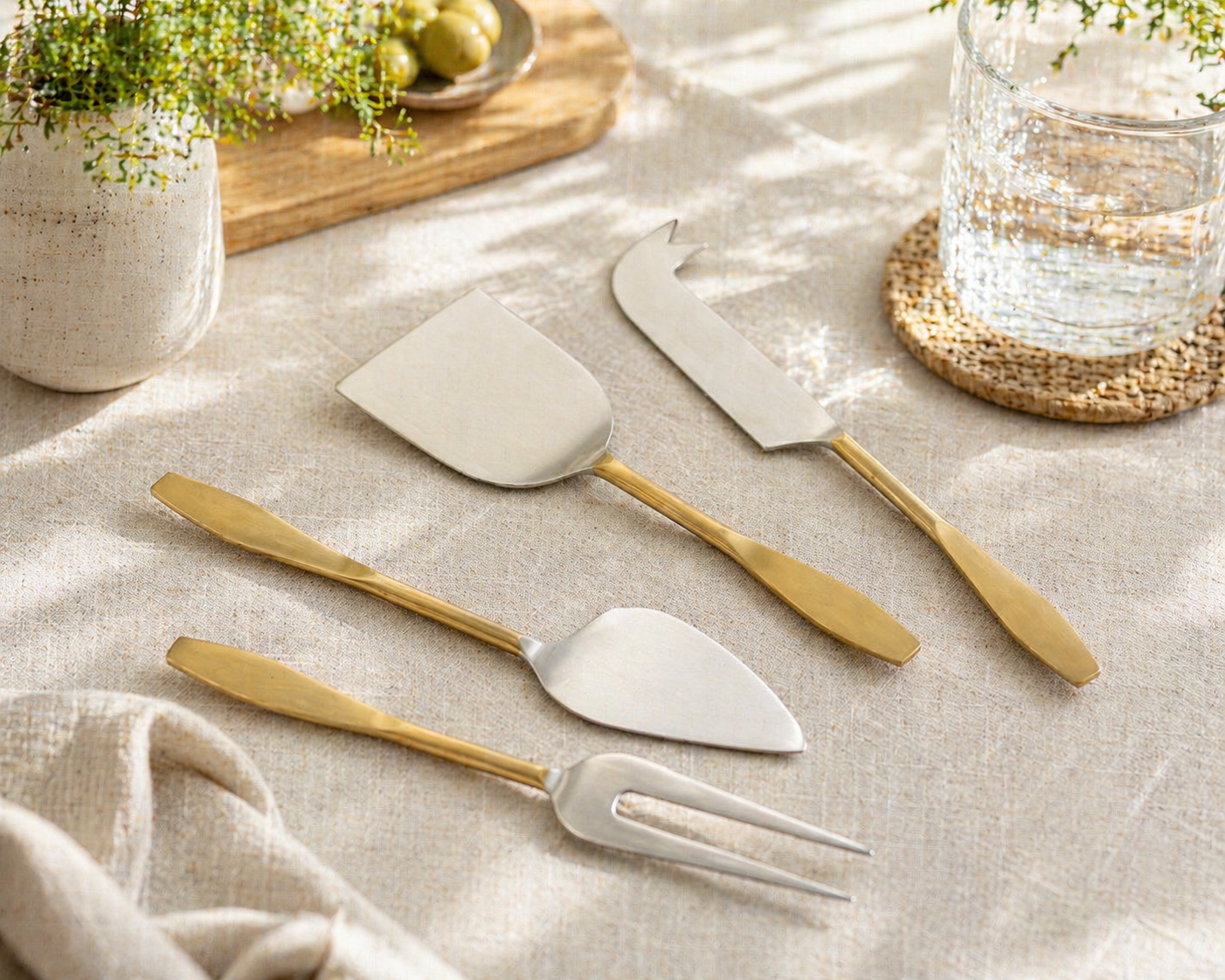




Why Are Cheese Knives Shaped Differently?
Most people own a general-purpose kitchen knife and assume it covers everything. It does not; at least not well. Cheese has a wide range of textures, from soft and creamy to firm and crumbly, and each texture presents a different cutting challenge. Cheese knife shapes are designed to solve those specific problems.
Wide, Flat Blades: A broad blade gives you more surface area to slice, lift, and transfer cheese in one clean move. This is especially useful for soft cheeses that break apart easily if handled too much. The width acts like a small spatula; cut and serve in one action.
Narrow, Pointed Blades: A narrower blade applies more focused pressure, which is exactly what you need when working through a firmer cheese like Cheddar or Gruyère. Less drag, more control, cleaner portions.
Forked or Pronged Tips: The fork at the end of a cheese knife is a serving tool, not decoration. Once you have cut a portion, the prongs let you lift and place it directly onto a plate or cracker without touching it; more hygienic, and much easier when entertaining a group.
The Cheese Fork: A dedicated cheese fork is used to hold the cheese steady while another knife does the cutting, and to pick up and pass individual pieces to guests. It keeps hands off the board entirely, which matters when you are hosting.
Understanding these design differences is the first step to using your cheese knife set properly. Our Aline Stainless Steel Cheese Cutlery Set includes four pieces, each with a specific job. Explore our wider Hosting essentials for more inspiration.
The 4 Pieces in the What a Host Home Cheese Knife Set
Here is exactly what each one does and which cheeses it is designed for.

Wide Blade Cheese Knife
Perfect for: Soft to semi-hard cheeses Use for: Brie, Camembert, Havarti, Young Gouda. The wide blade is the workhorse of the set. Its broad, flat surface makes it easy to slice, lift, and serve cheese neatly in one movement. No second implement needed. For soft cheeses like Brie or Camembert, this blade glides through without dragging or tearing. It also handles semi-hard cheeses like Havarti and Young Gouda well, where you want clean, even slices that hold their shape on the board. Serving tip: Always bring Brie and Camembert to room temperature before serving; at least 30 minutes out of the fridge. Cold soft cheese is much harder to cut and has significantly less flavour.

Spade Cheese Knife
Perfect for: Soft to semi-soft cheeses Use for: Brie, Goat cheese, Camembert, Fresh mozzarella The spade knife cuts, serves, and portions soft cheese with ease. Its tapered shape gives you good control when working with particularly delicate textures; fresh goat's cheese, for example, which can crumble if handled roughly. Where the wide blade knife excels at lifting larger portions, the spade knife is more precise. Use it when you need to cut individual servings cleanly, or when the cheese is especially soft and needs a more careful touch.
Serving tip: Fresh goat's cheese and Camembert are excellent with a little honey or a slice of fresh fig. The spade knife lets you portion neatly without dragging accompaniments into the cheese.

Cheese Fork
Perfect for: Serving and holding cheese while cutting Use for: Picking up, serving, and holding cheese while cutting; keeps hands clean while entertaining. The cheese fork does not cut; it serves. Use it to hold a block of cheese steady while another knife does the slicing, and then to lift and pass individual pieces to guests without touching them. On a busy cheese board with multiple guests helping themselves, a fork keeps the whole experience cleaner and more considered. It is also the right tool for moving small, delicate pieces; a crumbled edge of Brie or a thin slice of Goat cheese, without squashing them. Serving tip: Place the fork at the top of your board arrangement so guests can easily reach it. Position it near whichever cheese needs the most careful handling.

Pronged Cheese Knife
Perfect for: Semi-firm cheeses Use for: Cheddar, Gruyère, Gouda, Comté
The pronged knife is designed for firmer cheeses that need a bit more pressure to cut through cleanly. The blade is narrower and sturdier than the wide blade, which means it can work into the body of the cheese with more precision.
The prongs at the tip serve double duty; after cutting, you can spear a slice and move it directly to a plate or cracker in one action. For a semi-firm cheese like aged Cheddar or Comté, this knife gives you control over portion size and a clean finish on every slice. Serving tip: For aged Cheddar, pre-cut a few slices before guests arrive so the board looks inviting and people can help themselves easily. The pronged knife is ideal for this; you can cut and arrange in one fluid movement.


